MSc Thesis · ETH Zürich · 2024
Speech Recognition for Children with Congenital Disorders Using Adaptive Methods
Speech recognition has become good enough to be invisible for most people. For children with congenital speech disorders — the users who would benefit most — it largely does not work at all. This thesis asks how far a modern speech foundation model can be pushed toward one such speaker when the available data is a few hours from a single child.
- Degree
- MSc Computer Science — Machine Intelligence, ETH Zürich (graded top mark)
- Lab
- Supervised within ETH Zürich; with Roman Böhringer, Pehuén Patricio Moure and Dr. Yingqiang Gao
- Domain
- Automatic speech recognition · non-normative child speech · German / Swiss German
- Methods
- Whisper fine-tuning, layer insertion, LoRA / PEFT, synthetic speech, Wav2Vec2 comparison
- Read
- Full thesis (PDF, ETH Research Collection)
The problem
— and the long-term effects of unaddressed speech disability during schooling reach into mental health, social well-being and academic performance.
Whisper and its peers reach very low error rates on typical adult speech, but they inherit the distribution of their training data, and non-normative speech is barely present in it. The population studied here compounds the difficulty: children with congenital disorders such as Apert syndrome, speaking German with Swiss German as their first language — a low-resource language variety and an atypical speech pattern at the same time.
The binding constraint is data. The recordings come from a single child. That means very few hours, and almost no speaker variation for the model to generalise across, which makes overfitting the default outcome rather than an edge case.
The research question: can Whisper be fine-tuned or adapted to meaningfully improve recognition for one child with a speech impairment — and are foundation models the right tool for this problem at all?
Approach
The work is a systematic sweep over adaptation strategies, from crude to parameter-efficient, each evaluated by word error rate against held-out data:
- Baseline and capability checks — establish what pre-trained Whisper does on this speaker before touching anything.
- Partial training — freezing layers and applying dropout to constrain how much the model can memorise.
- Embedding adaptation — adjusting the input representation rather than the body of the network.
- Layer insertion — adding fresh transformer layers at chosen depths in the encoder and decoder, training only those.
- Low-rank adaptation (LoRA) — parameter-efficient fine-tuning at several ranks.
- Cross-validation and bias correction — validation splits and word-frequency weighting to check the numbers were real.
- Synthetic speech — text-to-speech augmentation to manufacture the variation the dataset lacks.
- Architecture comparison — the same treatment applied to Wav2Vec2, plus a fusion of the two models.
I also built the dataset: recording sessions, annotation, curation.
Results
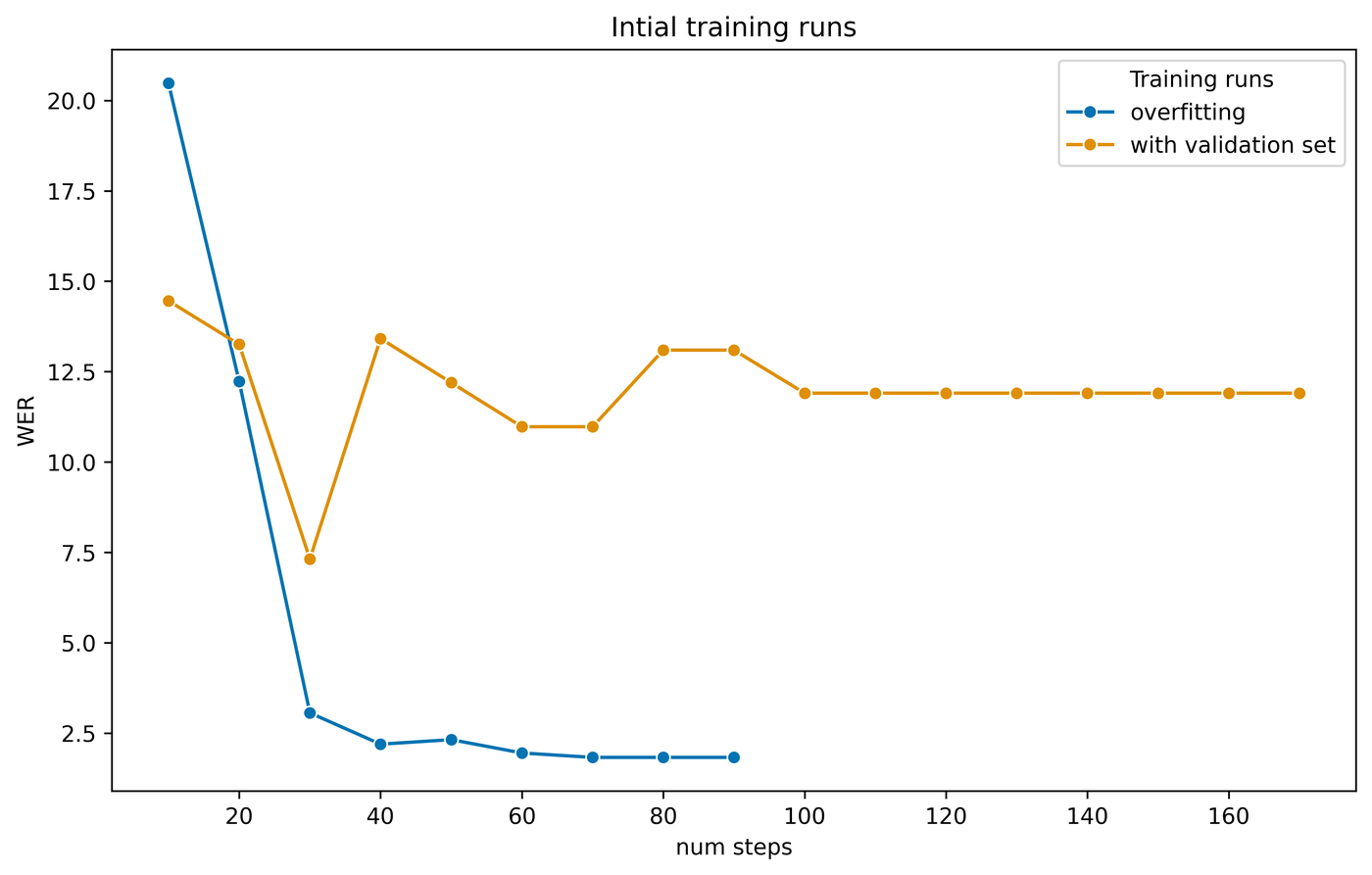
Fine-tuning on a single speaker collapses into memorisation almost immediately — the unconstrained run drives training error toward zero while genuine held-out performance settles roughly six times higher. Every subsequent experiment is really an answer to how do you adapt without simply memorising.
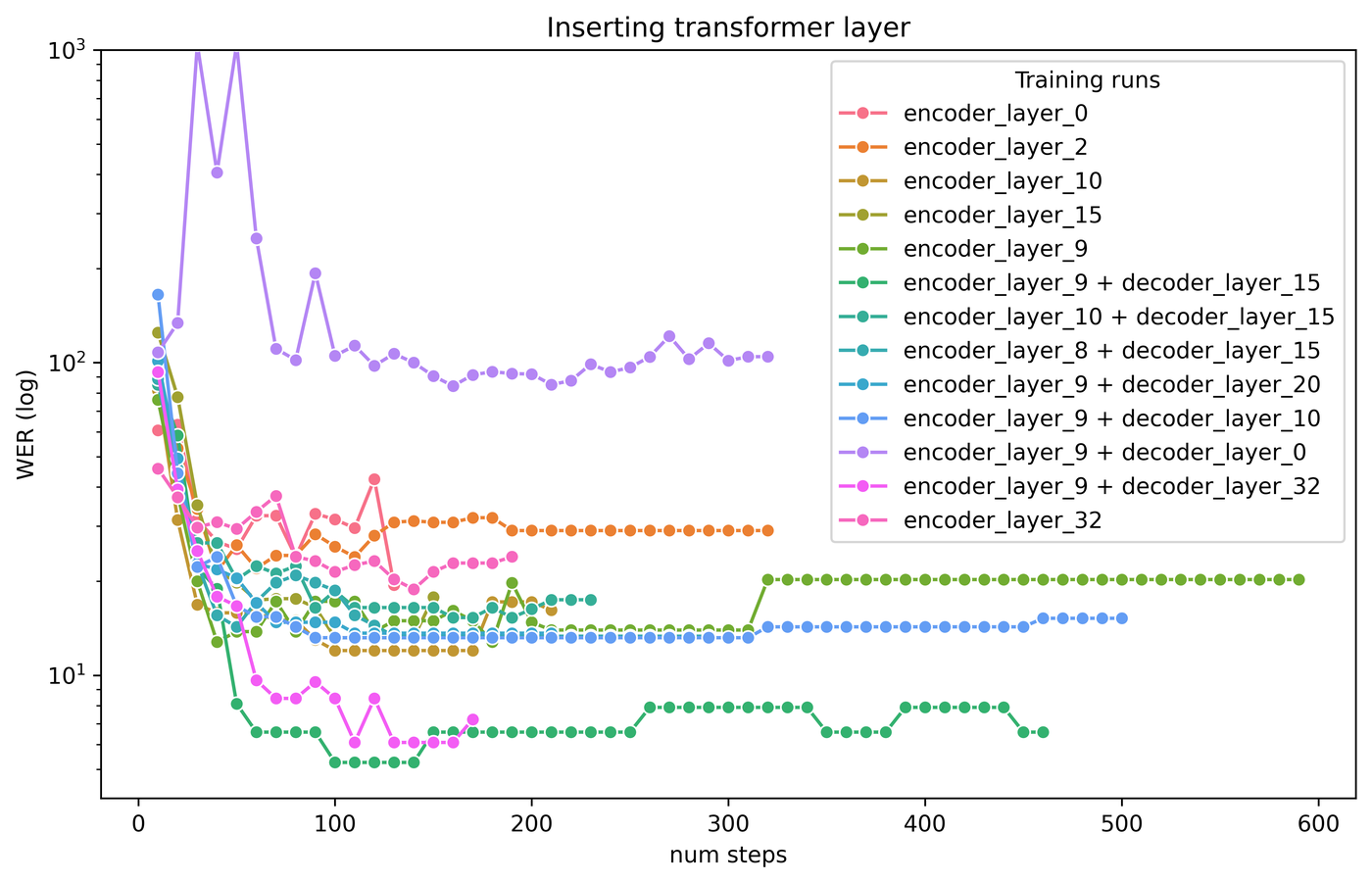
Layer insertion turned out to be the most informative axis. Placing new transformer layers at different encoder and decoder depths spreads final WER across more than an order of magnitude — the best configuration reaches roughly 6 WER, while a poorly placed decoder layer never recovers past ~100. Where you intervene in the network matters far more than how much you train.
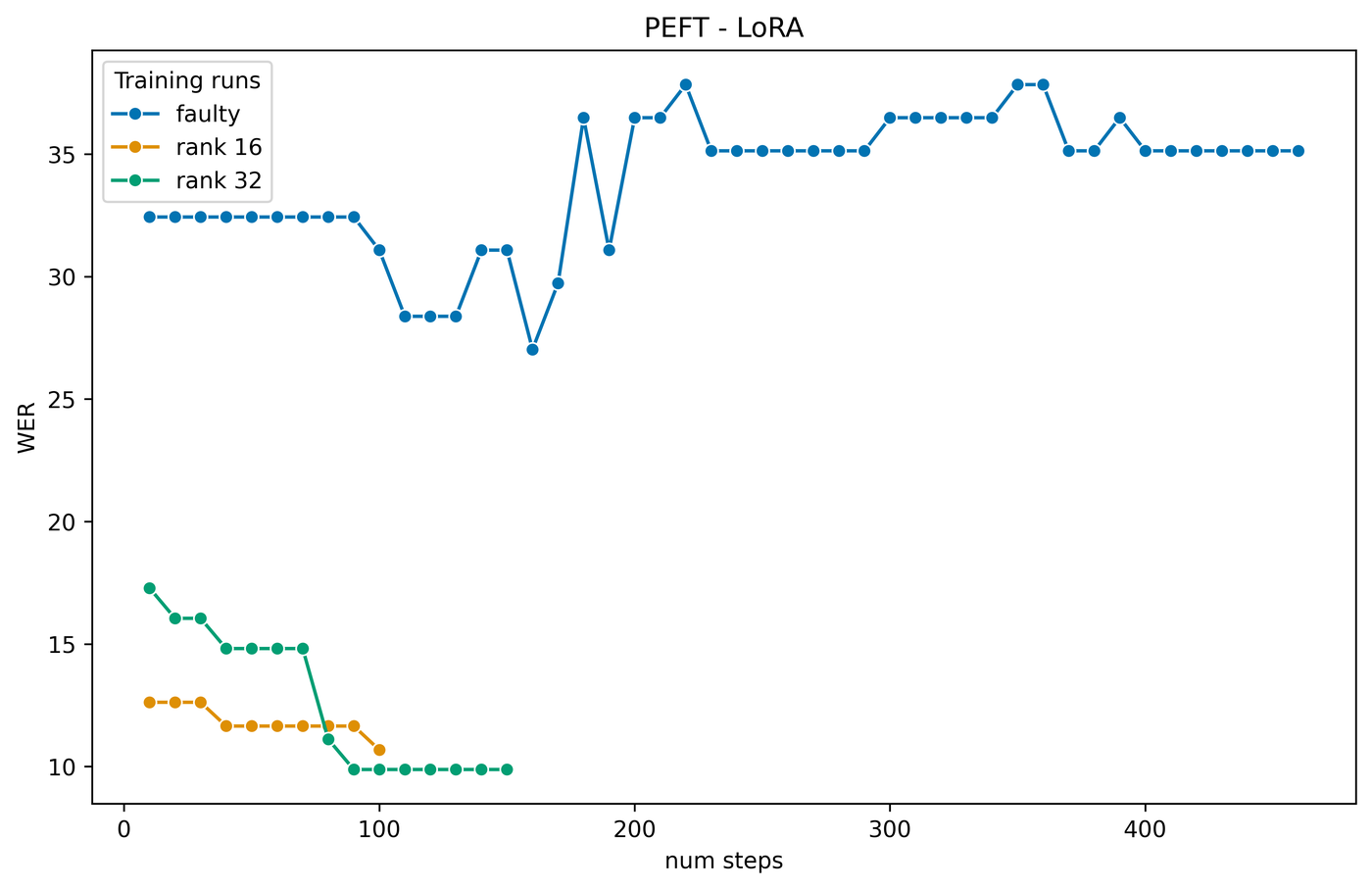
Low-rank adaptation reached comparable quality at a fraction of the trainable parameters, with ranks 16 and 32 both converging near 10 WER.
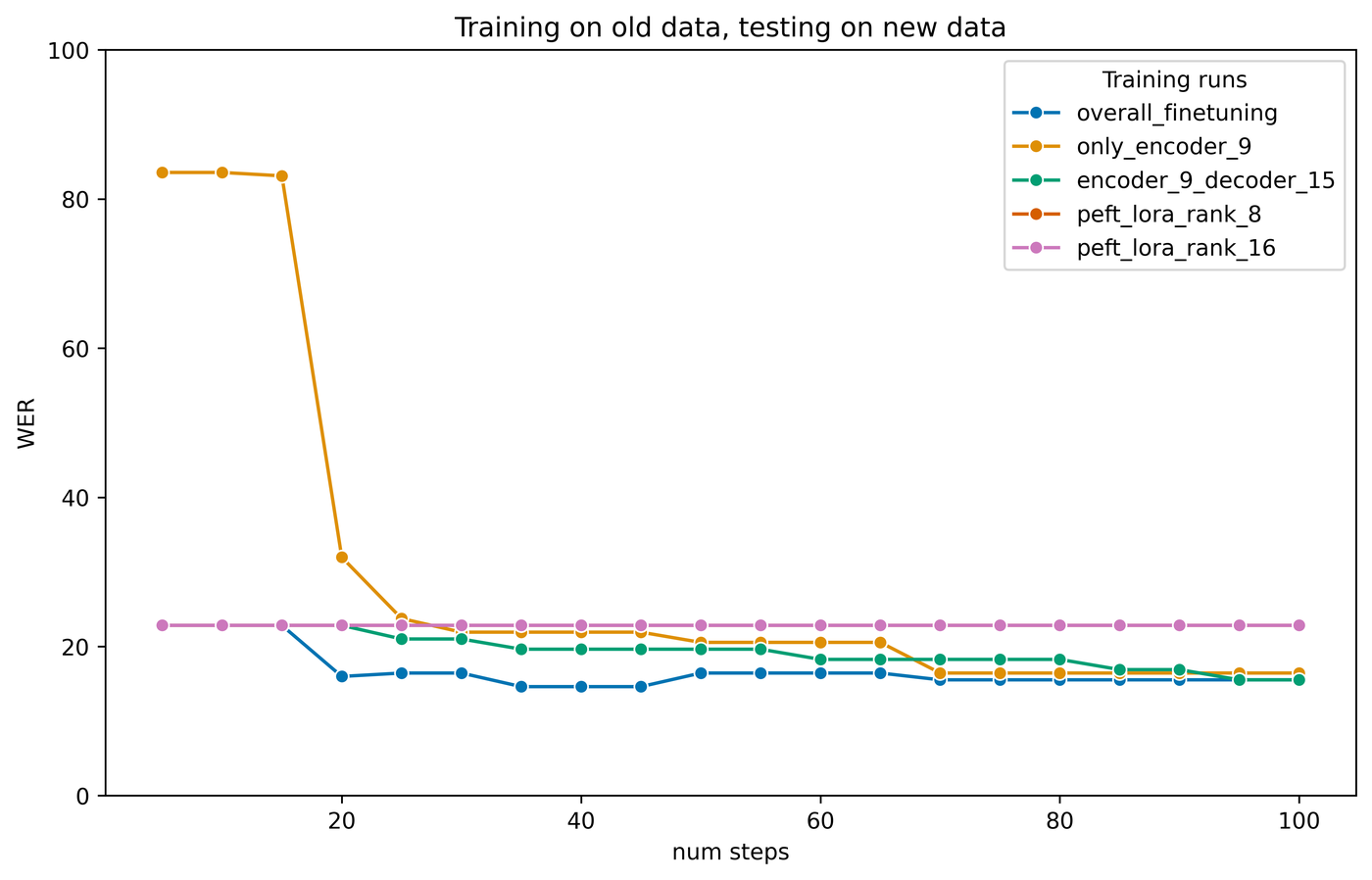
Adapted models also transferred across recording sessions: trained on the original data and tested on a later session of read speech, full fine-tuning held around 15 WER, confirming the gains were not an artefact of one afternoon in a recording room.
The honest result
Where it breaks
Every gain above is on read speech. Once conversational non-normative speech enters training and evaluation, error rates rise into the 40–75 WER range regardless of adaptation method — LoRA, layer insertion and full fine-tuning alike. The thesis does not resolve this, and says so.
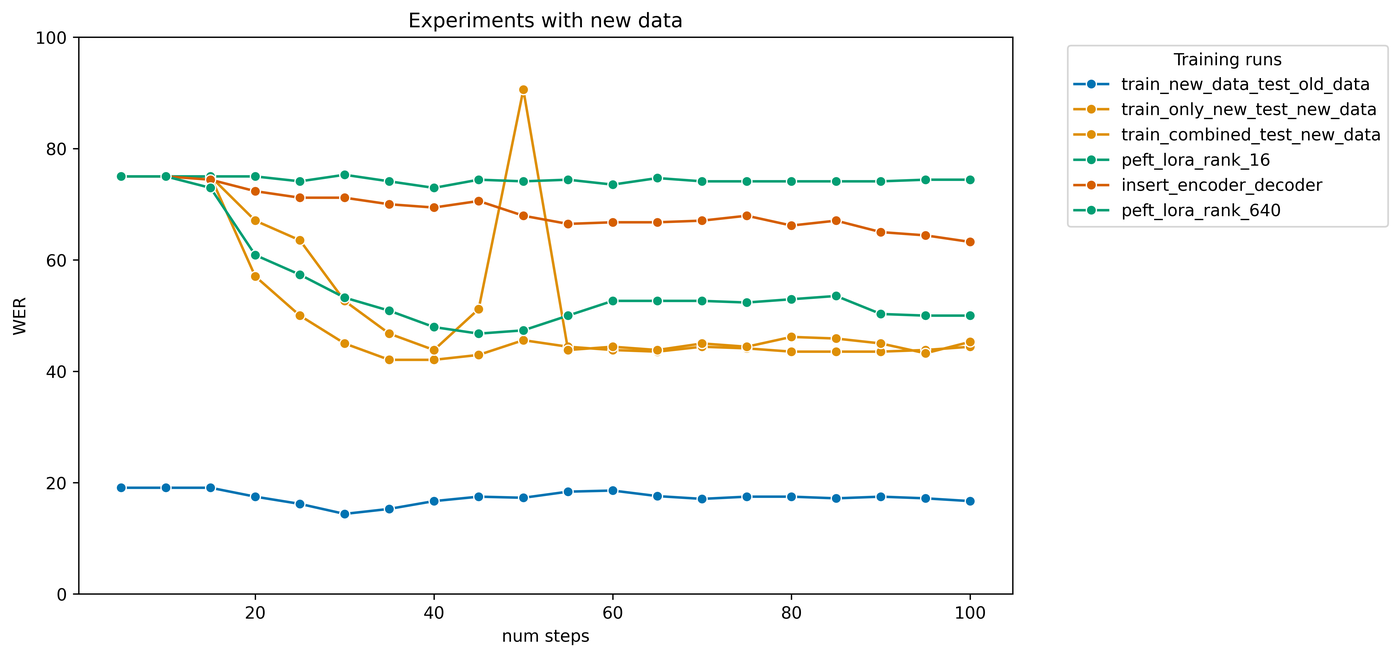
Whisper does well on read non-normative speech and fails on conversational non-normative speech, and no amount of parameter-efficient cleverness closed that gap on this data. The implication runs against the prevailing assumption: as foundation models advance, foundation models are weakest exactly where specialised methods are still needed.
Synthetic speech from off-the-shelf TTS did not meaningfully help Whisper, though it appeared more useful to Wav2Vec2 — suggesting that how well an architecture absorbs synthetic data is itself worth evaluating. And the bias-correction experiments showed how sensitive the headline numbers are to how you weight words, On data this small the evaluation needs as much scrutiny as the model.
What I would do next
The thesis closes on three directions: active learning, to spend a speaker’s limited recording time on the utterances that would teach the model most; robust Bayesian methods, to handle single-speaker uncertainty honestly; and data accessibility. The last is the real bottleneck. Datasets of non-normative speech barely exist.
Read the full thesis (PDF) · ETH Research Collection